Ethiopia
Federal Democratic Republic of Ethiopia
Local name: ኢትዮጵያ
Zoomed ×1.9
- Capital
- Addis Ababa
- Population
- 135.5 million
- 10th in the world (2025)
- Area
- 1,104,300 km²
- 26th in the world
- Density
- 123 people/km²
- 75th in the world
In brief
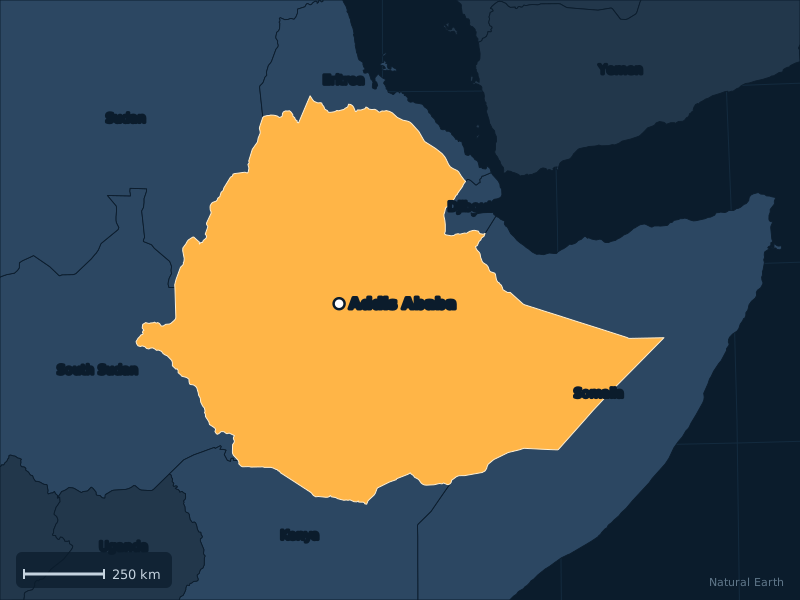
Ethiopia is a country in East Africa. Its capital is Addis Ababa. With 135.5 million inhabitants in 2025, it ranks 10th in the world by population, out of the 195 countries recognised by the UN. Its area is 1,104,300 km². Landlocked, it shares land borders with Djibouti, Eritrea, Kenya, Somalia, South Sudan and Sudan.
GDP per capita stands at $933 (2025), 179th in the world. Life expectancy at birth is 67.6 years (2024). 24% of the population lives in cities.
History of Ethiopia
The Kingdom of Aksum, one of the great states of antiquity, adopted Christianity in the 4th century; the rock-hewn churches of Lalibela date from the Middle Ages. In 1896 Emperor Menelik II crushed the Italian army at Adwa: Ethiopia escaped colonisation, despite an Italian occupation from 1936 to 1941. Emperor Haile Selassie was overthrown in 1974 by a communist junta, the Derg, itself ousted in 1991. Abiy Ahmed, prime minister since 2018, won the Nobel Peace Prize in 2019; a war devastated Tigray from 2020 to 2022. Addis Ababa hosts the headquarters of the African Union.
Geography of Ethiopia
Landlocked since Eritrea’s independence, Ethiopia is dominated by high plateaus, the “roof of Africa”, cut by the Great Rift Valley. The Blue Nile rises at Lake Tana. Ras Dashen (4,550 m) contrasts with the Danakil Depression, below sea level. It is Africa’s second most populous country.
Map of Ethiopia
Flag of Ethiopia
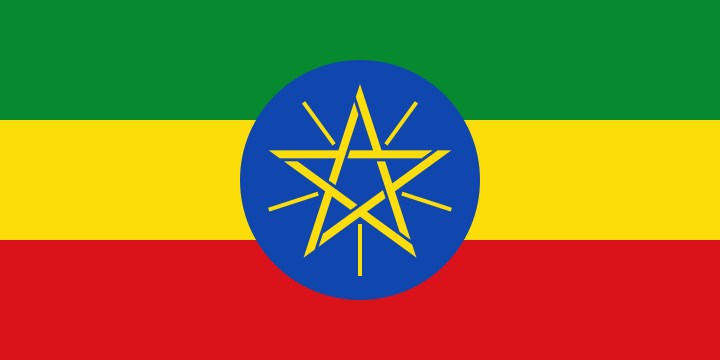
The flag of Ethiopia is red, blue, green and yellow. Its official proportions are 1:2 (height to width).
- Green31%
- Red30%
- Yellow25%
- Blue14%
Share of the flag’s surface taken by each colour.
What the flag stands for
Green, yellow and red, with a blue disc bearing a yellow star. As symbols of a country never colonised, these colours inspired the pan-African colours adopted by many states at independence. The current emblem, adopted in 1996, represents the unity of Ethiopia’s peoples.
Sources: Wikipedia, articles “Ethiopia” and “Flag of Ethiopia”.
See also: flags with a star.
Download the flag (SVG) All 2 red, blue, green and yellow flags All the flags of the world
Fact file
| Official name | Federal Democratic Republic of Ethiopia |
|---|---|
| Capital | Addis Ababa |
| Official language | Amharic |
| Currency | Ethiopian birr (ETB, Br) |
| Demonym | Ethiopian |
| Continent | Africa, East Africa |
| Access to the sea | No, landlocked |
| Area | 1,104,300 km² |
| Calling code | +251 |
| Internet domain | .et |
| UN status | Member state |
Economy and society
GDP per capita
$933
179th in the world (2025)
Life expectancy
67.6 years
at birth (2024)
Urban population
24%
Sources: World Bank (2025) for population and economy, Natural Earth for the map, mledoze/countries and Wikidata for reference data. Method.