
Hungary
Local name: Magyarország
Zoomed ×4.5
- Capital
- Budapest
- Population
- 9.5 million
- 96th in the world (2025)
- Area
- 93,028 km²
- 108th in the world
- Density
- 102 people/km²
- 87th in the world
In brief
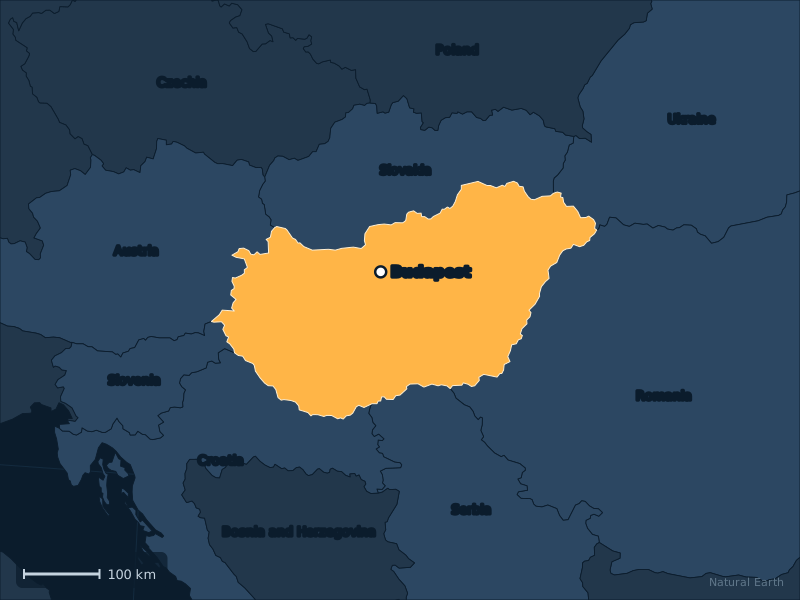
Hungary is a country in Central Europe. Its capital is Budapest. With 9.5 million inhabitants in 2025, it ranks 96th in the world by population, out of the 195 countries recognised by the UN. Its area is 93,028 km². Landlocked, it shares land borders with Austria, Croatia, Romania, Serbia, Slovakia, Slovenia and Ukraine.
GDP per capita stands at $25,907 (2025), 50th in the world. Life expectancy at birth is 76.7 years (2024). 71% of the population lives in cities.
History of Hungary
The Magyars settled in the Carpathian Basin at the end of the 9th century. Stephen I, crowned in the year 1000, founded a Christian kingdom. After defeat by the Ottomans at Mohács in 1526, the country gradually passed to the Habsburgs; the revolution of 1848 was crushed, and the Compromise of 1867 created Austria-Hungary. The Treaty of Trianon (1920) took away two thirds of its territory. The 1956 uprising against the USSR was put down; Hungary returned to democracy in 1989 and joined the European Union in 2004.
Geography of Hungary
Landlocked Hungary lies at the heart of the Pannonian plain: the Great Plain in the east and hills in the west. The Danube runs north to south through Budapest. Lake Balaton is the largest lake in Central Europe; Kékes (1,014 m) is the highest point.
Map of Hungary
Flag of Hungary
The flag of Hungary is red, white and green. Its official proportions are 1:2 (height to width).
- Red33%
- White33%
- Green33%
Share of the flag’s surface taken by each colour.
What the flag stands for
Red, white and green, taken from the national coat of arms. They are traditionally read as strength, faithfulness and hope. The tricolour took hold during the revolution of 1848.
Sources: Wikipedia, articles “Hungary” and “Flag of Hungary”.
Download the flag (SVG) All 12 red, white and green flags All the flags of the world
Fact file
| Official name | Hungary |
|---|---|
| Capital | Budapest |
| Official language | Hungarian |
| Currency | Hungarian forint (HUF, Ft) |
| Demonym | Hungarian |
| Continent | Europe, Central Europe |
| Access to the sea | No, landlocked |
| Area | 93,028 km² |
| Calling code | +36 |
| Internet domain | .hu |
| UN status | Member state |
Economy and society
GDP per capita
$25,907
50th in the world (2025)
Life expectancy
76.7 years
at birth (2024)
Urban population
71%
Sources: World Bank (2025) for population and economy, Natural Earth for the map, mledoze/countries and Wikidata for reference data. Method.